
A thangka painting rarely stands alone. Behind every deity and mandala sits a lineage of teachers who carried these practices forward, generation after generation, often at great personal cost.
In Tibetan Buddhism, these teachers are called lamas, a word that simply means “guru” or “one who shows the way.”
A lama thangka is a painting built around one of these specific, historical teachers rather than a purely symbolic deity form.
What Makes a Lama Thangka Different From a Deity Thangka
Lama thangkas hold a slightly different place in the tradition than deity thangkas.A deity thangka is usually painted as an object of meditation, a form to visualize and connect with directly during practice.
A lama thangka is closer to a portrait of devotion. It honors a specific human being, often shown with the exact hand gestures, robes, and ritual objects tied to their life and teaching, so that a practitioner can hold their example in mind while studying the path they laid out.This distinction matters for anyone choosing a thangka for the first time.
If you want a painting that functions purely as a symbolic support for meditation, a deity thangka is the more traditional choice.If you want a painting that honors a specific teacher, their story, and the lineage of instruction they represent, a lama thangka carries that meaning in a way a deity form simply cannot.
Milarepa, the Yogi Who Sang His Realization
Milarepa is one of the most loved figures in Tibetan Buddhism, and one of the few whose life story is told almost like a folk tale rather than a formal biography.Before he became a teacher, he lived through a difficult and turbulent early life, and his path to realization was neither quiet nor easy.
What sets him apart is how he taught. Rather than writing dense philosophical treatises, Milarepa expressed his under -standing through spontaneous songs, simple in language but direct in meaning, which are still studied and recited today by students of Tibetan Buddhism around the world.
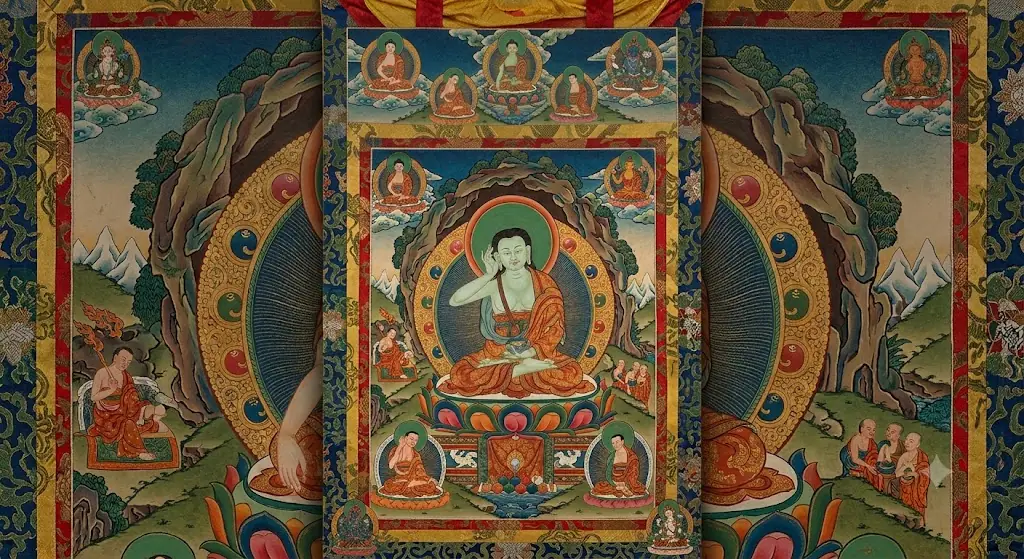
In thangka paintings, Milarepa is usually shown seated in a cave, his hand raised to his ear, a gesture tied to the act of singing his teachings aloud.That single detail, the hand at the ear, is what makes him instantly recognizable across almost every version of his image, regardless of the artist or region.
His body is typically painted in a pale green or white tone, a nod to the stories describing his diet of nettles during years of solitary retreat, and this detail alone tells a practitioner familiar with his life exactly which teacher they are looking at before reading a single word.
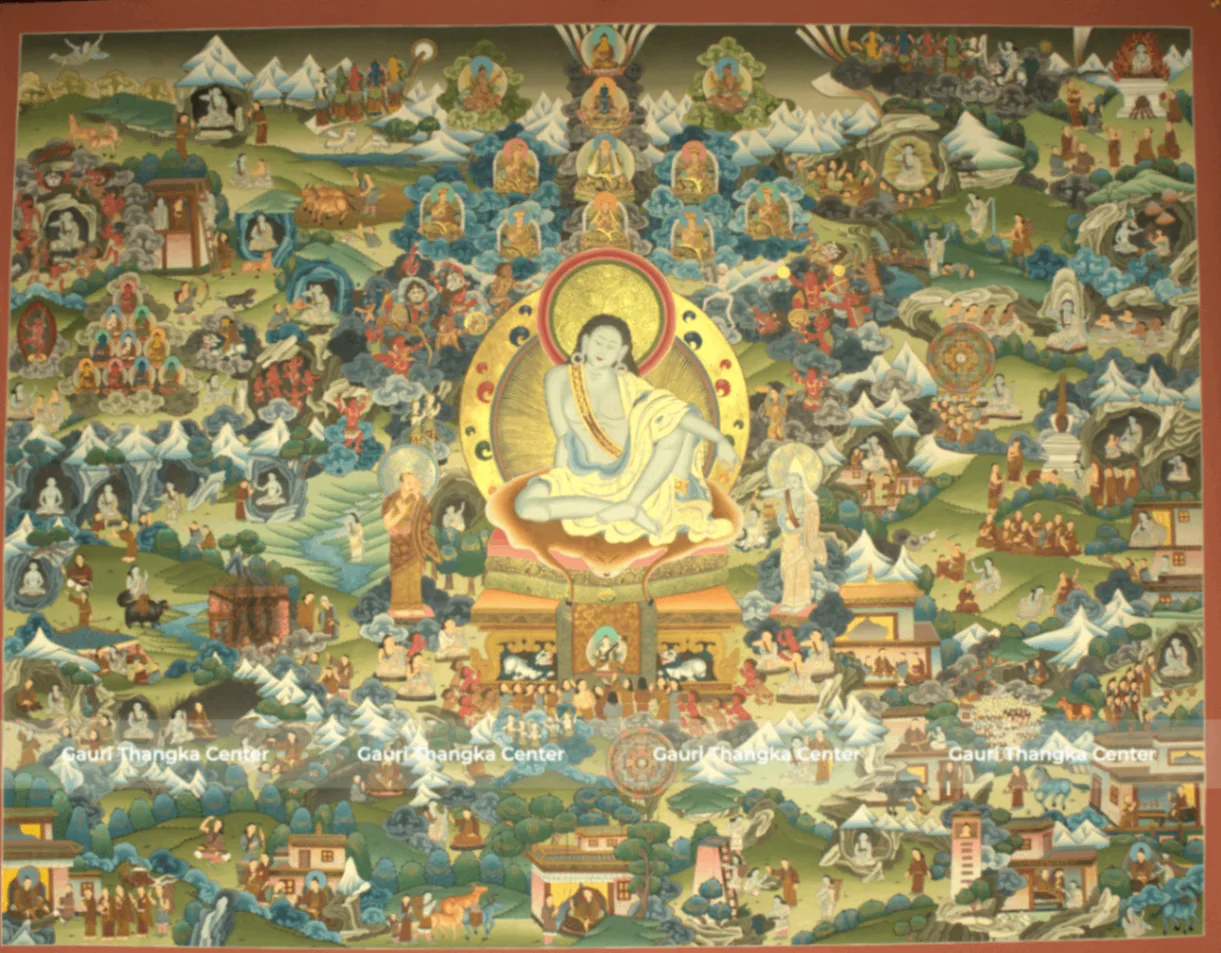
Gauri Thangka’s Milarepa thangka follows this traditional composition, hand painted in Kathmandu using the same iconographic details that have identified him for centuries.
Guru Rinpoche, the Lotus Born Master
Guru Rinpoche, also known as Padmasambhava, holds a central place in Tibetan Buddhism as the master credited with helping establish Buddhist practice in Tibet.
He is shown seated in a specific and consistent way, holding a vajra in one hand and a skull cup in the other, a lotus flower and khatvanga staff resting against his shoulder.Practitioners across multiple schools of Tibetan Buddhism include him in their devotional practice, which is part of why his image appears so widely in thangka art, more widely than almost any other single teacher.
Guru Rinpoche’s thangkas often appear in sets, since his life and teaching activity are traditionally described through eight distinct manifestations, each representing a different aspect of his work.A single Guru Rinpoche thangka usually shows his most common central form, while collectors building a more complete shrine sometimes look for additional forms over time.
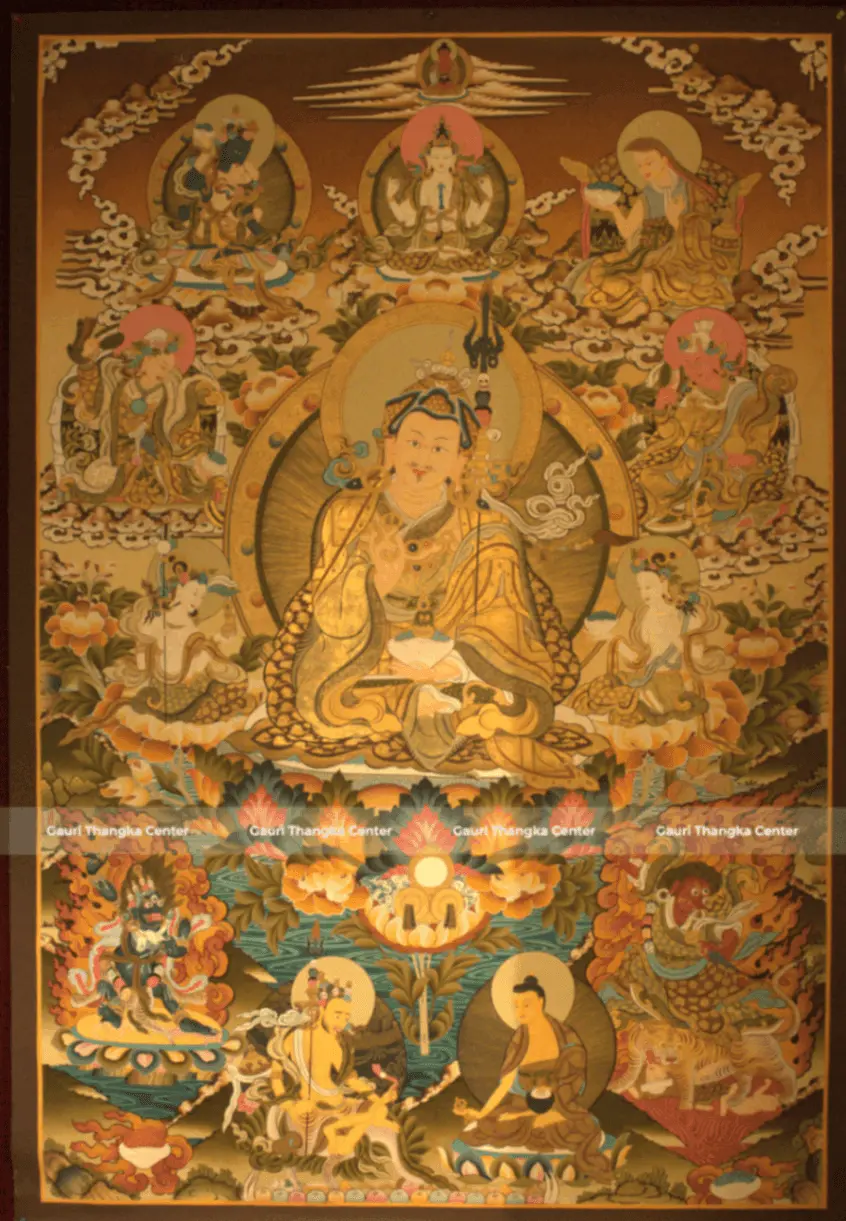
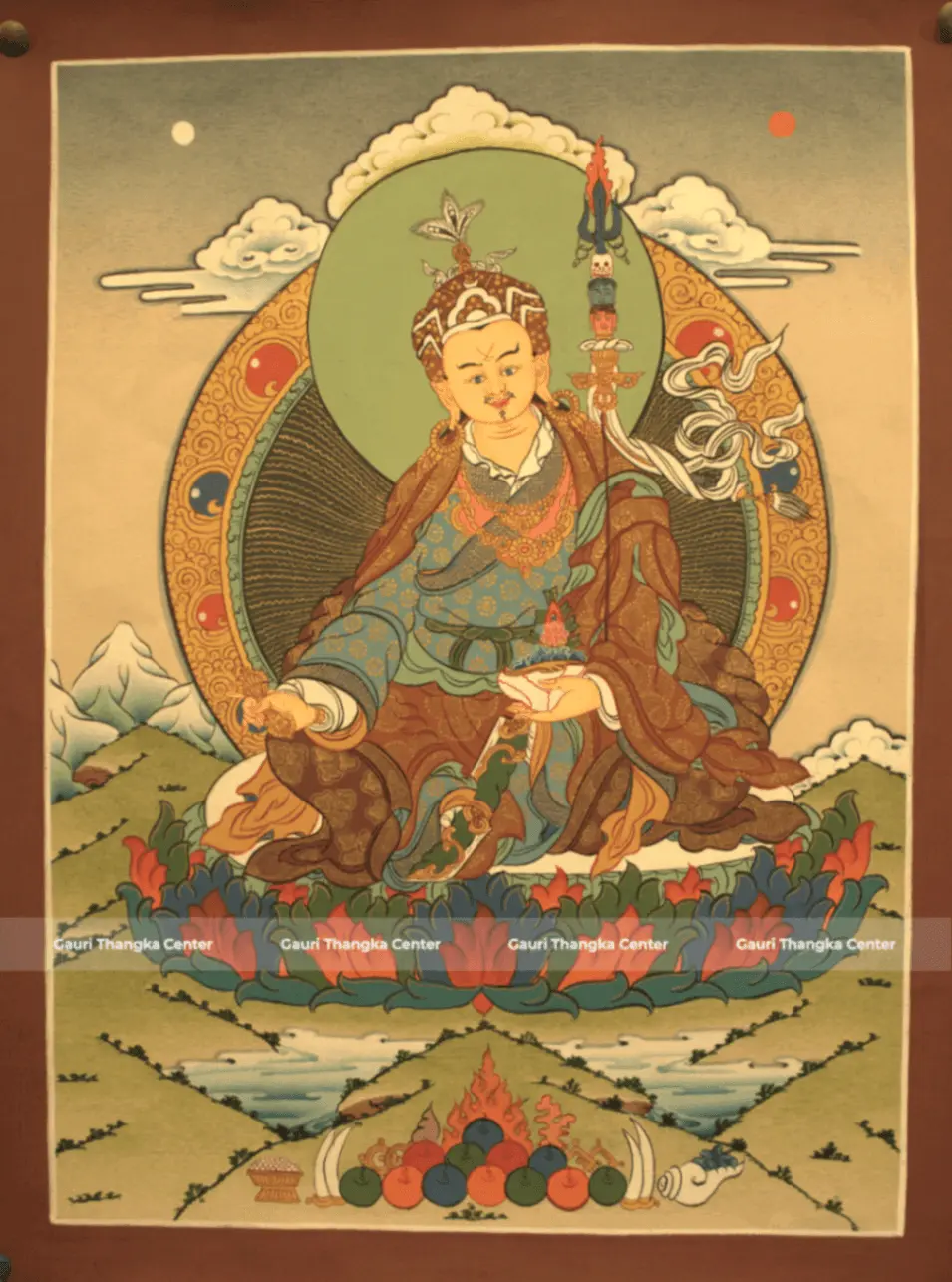
Gauri Thangka’s Guru Rinpoche thangka collection follows this traditional form, hand painted with the same attention to posture and ritual detail that has been passed down through generations of thangka artists in the Kathmandu Valley.
The Wider Tradition of Lama Lineages
Beyond Milarepa and Guru Rinpoche, Tibetan Buddhism holds a long list of teachers whose images appear in thangka art, each tied to a specific school or lineage.
Je Tsongkhapa is remembered as the founder of the Gelug school and is usually shown seated with a sword and scripture resting on lotus blossoms at his shoulders.Marpa the Translator is remembered as Milarepa’s own teacher, the figure who brought core tantric teachings from India into Tibet and trained Milarepa through a famously demanding apprenticeship.
Successive Karmapas, the heads of the Karma Kagyu school, are painted wearing the distinctive black crown associated with their lineage.These figures are part of the same broader tradition of lama thangkas, even where a specific painting isn’t yet part of a given collection.
How Lama Thangkas Fit Into a Shrine or Meditation Space
In a traditional shrine arrangement, a lama thangka is often placed above or alongside the deity or Buddha form central to a practitioner’s own practice, since the lineage teacher is understood as the source through which that practice was transmitted.
This is one of the reasons collectors who already own a deity thangka often add a lama thangka next, not to replace the deity form but to complete the relationship between practice and teacher.
For someone building a shrine from scratch, starting with a lama thangka tied to a teacher whose story resonates personally is just as valid a starting point as beginning with a deity.
Why Lama Thangkas Matter to Collectors and Practitioners
For a practitioner, a lama thangka is a way of keeping a teacher’s presence close, a visual reminder of a specific lineage and the qualities that teacher embodied.For a collector, these paintings carry a different kind of weight.
They are often more narratively rich than a purely symbolic deity thangka, since each detail in the composition ties back to a documented moment or teaching from that master’s life, which gives the painting a story to point to rather than only a symbolic reading.
If you are choosing between a deity thangka and a lama thangka for your own space, it often comes down to what you want the painting to hold.
A deity thangka is usually chosen as an object of meditation and protection.A lama thangka is closer to choosing a teacher whose example you want to keep in view, day after day, in the room where you practice.
Browse the full Thangka collection to see how lama paintings sit alongside deity and mandala thangkas in the wider tradition.
Frequently Asked Questions
A deity thangka depicts a Buddha or Buddhist deity as a symbolic form for meditation, while a lama thangka depicts a specific historical teacher, shown with details tied to their actual life and teaching.
The gesture represents the act of singing, since Milarepa is remembered for teaching through spontaneous songs of realization rather than formal written texts.
Yes. Many practitioners are drawn to a specific teacher’s story before they deepen their study of a particular deity practice, and a lama thangka can be a meaningful starting point for a home shrine.
Yes. They follow the same traditional process using natural mineral pigments, gold detailing, and cotton canvas, the only difference is the subject being depicted.